
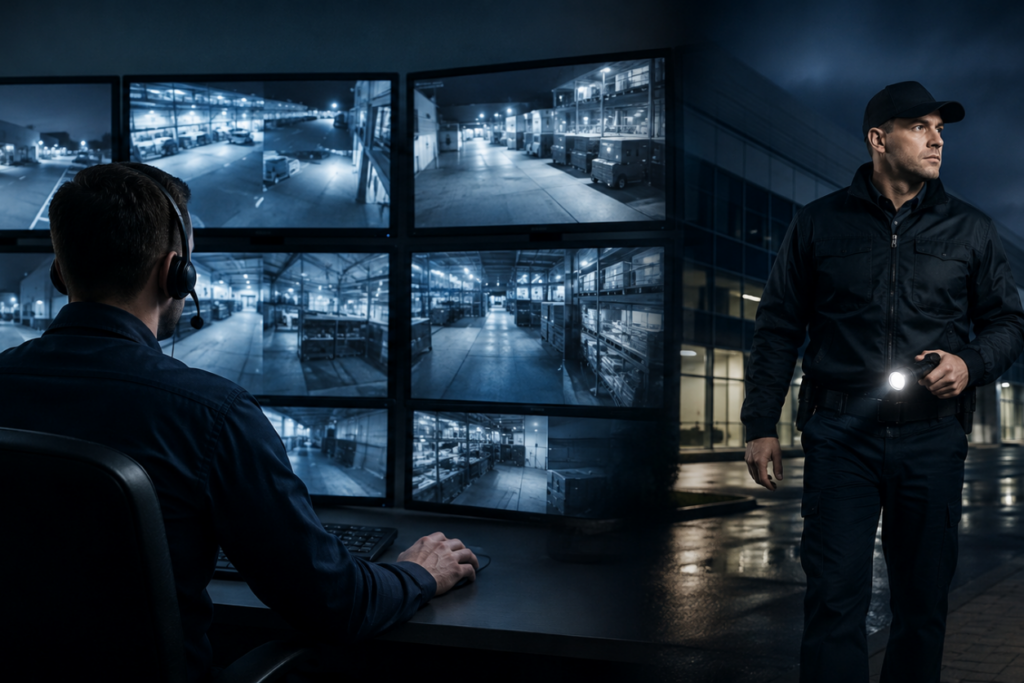
CCTV Monitoring vs Security Guards: Which Security Option Is Right for Your Business?
Businesses often face the same security question: should they invest in CCTV monitoring or security guards?
Both provide useful protection, but they work in very different ways. CCTV monitoring gives businesses continuous visibility across selected areas, while security guards provide a physical presence that can control access, patrol a property, interact with people, and respond to situations on site.
The right choice depends on your property, security risks, operating hours, layout, and the type of response you need.
For some businesses, CCTV monitoring may provide enough coverage. Others may need a security guard on site. Larger or higher-risk properties may benefit from combining both.
CCTV Monitoring vs Security Guards: What’s the Difference?
The biggest difference is simple:
CCTV monitoring watches your property. Security guards physically protect and respond at the property.
CCTV cameras can monitor entrances, parking areas, loading docks, storage areas, and other locations from a central monitoring system. With live monitoring, trained operators can review activity as it happens and follow an agreed response procedure.
Security guards, on the other hand, are physically present at your property. They can check identification, control access, patrol areas, monitor deliveries, speak with visitors, and respond directly to security concerns.
Neither option does everything the other can do.
What Does CCTV Monitoring Provide?
CCTV monitoring is more than simply installing cameras and recording footage.
With professional monitoring, cameras can provide continuous visibility while trained operators review activity and respond to alerts according to the property’s security procedures.
CCTV monitoring can be useful for:
-
Monitoring large areas
-
Watching entrances and exits
-
Checking parking lots
-
Monitoring loading areas
-
Detecting suspicious activity
-
Reviewing security incidents
-
Providing video evidence
For businesses that already have cameras installed, professional CCTV monitoring services in Edmonton can turn passive surveillance into an actively monitored security layer.
Advantages of CCTV Monitoring
Wide Area Coverage
A strategically designed camera system can cover multiple parts of a property at the same time.
This can be particularly useful for large commercial properties, warehouses, parking areas, and sites with several access points.
Continuous Monitoring
Cameras can operate around the clock, including weekends and holidays.
This is especially useful when a property is empty outside normal business hours.
Recorded Evidence
Security footage can help businesses review what happened after an incident and may assist with internal investigations, insurance matters, or law enforcement requests.
Less Physical Presence Required
CCTV does not require a person to remain physically stationed at every monitored location.
This can make it practical for businesses that need visibility across a large area.
What Do Security Guards Provide?
Security guards provide something cameras cannot: a physical security presence.
Depending on the assignment, guards can monitor entrances, check visitors, patrol the property, manage access, observe deliveries, document incidents, and respond to problems in person.
Security guard services in Edmonton can be structured around specific posts, schedules, access points, and property risks.
Advantages of Security Guards
Physical Deterrence
A visible uniformed guard can discourage unauthorized activity simply by being present.
Immediate On-Site Interaction
A guard can speak directly with visitors, employees, contractors, drivers, or unauthorized individuals.
Access Control
Guards can verify people entering a property and help control restricted areas.
Physical Patrols
A guard can move through areas that cameras may not fully cover, checking doors, storage areas, parking lots, and perimeter locations.
Human Judgment
Not every unusual event is a security threat. Guards can assess situations in person and make decisions based on what they observe.
CCTV Monitoring vs Security Guards: Side-by-Side Comparison
| Security Factor | CCTV Monitoring | Security Guards |
|---|---|---|
| Remote visibility | Yes | No |
| Physical presence | No | Yes |
| Access control | Limited to system controls | Yes |
| Live observation | Yes, with active monitoring | Yes |
| Physical patrols | No | Yes |
| Visitor interaction | No | Yes |
| Recorded video | Yes | Depends on equipment |
| Large-area coverage | Strong | Limited by patrol range |
| Immediate physical intervention | No | Yes |
| Evidence collection | Video footage | Reports and observations |
| Best suited for | Monitoring and detection | Presence and response |
When Is CCTV Monitoring a Better Fit?
CCTV monitoring can be a practical option when your main requirement is visibility across a property.
It may make sense for:
-
Warehouses
-
Large commercial properties
-
Parking facilities
-
Storage yards
-
Vacant or lightly staffed properties
-
Businesses operating after hours
For example, a warehouse may have several loading docks, exterior storage areas, employee entrances, and parking zones. A camera system can give operators visibility across those areas without placing a guard at every point.
That does not mean cameras eliminate the need for physical security. It means they can provide broad surveillance where permanent physical coverage may not be necessary.
When Are Security Guards a Better Fit?
Security guards become more useful when your property requires someone to physically interact with people or take action on site.
Guards may be appropriate for:
-
Busy commercial buildings
-
Office properties
-
Retail locations
-
Construction sites
-
Warehouses with valuable inventory
-
Properties with frequent trespassing
-
Sites requiring access control
-
Locations with significant after-hours activity
A guard can verify a delivery, challenge an unauthorized person, check a door, assist an employee, or investigate an unusual situation immediately.
These are tasks a camera system cannot physically perform.
Which Option Costs More?
Cost depends heavily on the size of the property, number of cameras, monitoring requirements, guard hours, security risks, and level of coverage.
CCTV usually involves an initial equipment and installation investment followed by monitoring and maintenance costs.
Security guards are generally an ongoing staffing expense based on the number of hours and personnel required.
Comparing the two only by hourly or monthly price can be misleading.
A cheaper system that leaves major security gaps may cost more after a theft, break-in, or serious incident.
The better approach is to compare the coverage you receive for the actual risks you need to manage.
Can CCTV Monitoring Replace Security Guards?
Sometimes, but not in every situation.
If the primary need is watching a large property and identifying suspicious activity, monitored CCTV may provide substantial coverage.
If the business needs someone to control an entrance, patrol the property, verify visitors, manage deliveries, or respond physically, cameras cannot perform those duties.
This is why many businesses use a layered security approach instead of choosing one technology or service exclusively.
Why a Combination of CCTV and Security Guards Can Work Better
CCTV and security guards can complement each other.
Cameras provide visibility across the property while guards provide physical presence where it matters most.
For example:
CCTV: Monitors the parking lot, loading dock, and exterior perimeter.
Security Guard: Controls the main entrance, checks visitors, patrols the property, and responds to incidents.
Mobile Patrol: Performs additional inspections during selected hours.
Alarm Response: Provides a response when an alarm or security event requires physical investigation.
For larger Edmonton properties, mobile patrol security services in Edmonton can provide additional physical checks without requiring a permanent guard at every location.
CCTV Monitoring vs Security Guards for Different Businesses
Warehouses
Warehouses often benefit from CCTV because of their large footprint, multiple entrances, loading docks, and storage zones.
A combination of cameras and physical patrols can provide broader coverage while keeping important access points monitored.
Offices
Office buildings may place greater emphasis on visitor management, access control, employee safety, and reception security.
A security guard can provide a visible presence while CCTV supports monitoring of entrances, elevators, hallways, and other areas.
Retail Stores
Retail businesses may require a combination of surveillance, employee support, loss prevention, and physical security.
The right solution depends on store size, customer traffic, inventory value, and operating hours.
Construction Sites
Construction sites can have valuable equipment and materials spread across open areas.
CCTV can monitor the site, while guards or mobile patrols can physically inspect the property and identify issues that cameras may not fully capture.
What About After-Hours Security?
After-hours security is where the difference between CCTV monitoring and security guards becomes especially important.
A monitored CCTV system can identify activity when the property is empty and follow a predefined response process.
A guard already on site can investigate the situation immediately.
For businesses that need a response to alarms without keeping employees on call, alarm and emergency response security services in Edmonton can be included as another layer of protection.
How to Choose Between CCTV Monitoring and Security Guards
Before making a decision, look at five factors:
1. Property Size
Large properties may need cameras to provide broad visibility, combined with patrols or guards for physical checks.
2. Security Risk
A property with frequent theft, vandalism, trespassing, or access issues may require a stronger physical presence.
3. Operating Hours
Businesses with 24-hour operations may require continuous physical coverage, while other properties may have greater security needs only after closing.
4. Access Requirements
If someone needs to verify visitors, control gates, manage deliveries, or restrict access, security guards provide a function CCTV cannot.
5. Response Requirements
Ask what should happen when suspicious activity is detected.
If detection is enough, CCTV may meet the need.
If someone must physically investigate or intervene, additional on-site security or response services may be necessary.
Frequently Asked Questions
Is CCTV better than security guards?
Neither is universally better. CCTV provides surveillance and broad visibility, while security guards provide physical presence, access control, patrols, and on-site response.
Can security cameras work without monitoring?
Yes. Cameras can record footage without live monitoring. However, recorded CCTV generally helps investigate an incident after it happens, while live monitoring allows suspicious activity to be assessed as it occurs.
Are security guards necessary if a business has CCTV?
Not always. The need depends on the property’s risks and whether physical access control, patrols, visitor management, or immediate on-site response is required.
What is the best security option for a warehouse?
It depends on the warehouse’s size, inventory value, loading activity, operating hours, and risk level. CCTV monitoring can provide broad visibility, while guards or mobile patrols can provide physical protection and inspections.
Can CCTV and security guards be used together?
Yes. Combining CCTV monitoring with guards or mobile patrols can create multiple layers of protection, with cameras providing visibility and security personnel providing physical response.
Final Thoughts
The CCTV monitoring vs security guards decision should not be based on which option sounds more advanced or costs less at first glance.
CCTV is strongest at providing visibility across multiple areas and helping detect and document activity. Security guards are strongest when a business needs a physical presence, access control, patrols, human judgment, and on-site response.
For many commercial properties, the practical solution is not choosing one and eliminating the other. A combination of monitored CCTV, security guards, mobile patrols, and alarm response can provide different layers of protection according to the property’s actual risks.
The right security strategy starts with the property itself: its layout, people, assets, operating hours, access points, and history of security incidents.