
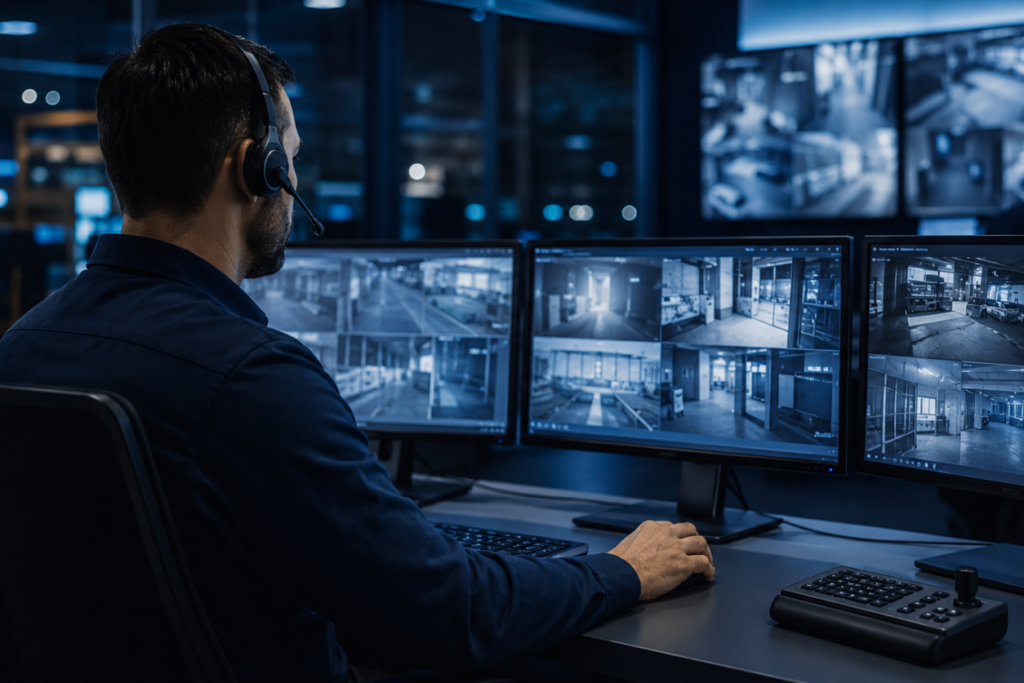
Benefits of Remote Video Monitoring: How It Improves Business Security
Security cameras are common across commercial properties, warehouses, construction sites, parking areas, and industrial facilities. But simply recording video is not the same as actively monitoring a property.
With traditional CCTV, footage may sit unused until someone needs to review it after an incident. Remote video monitoring adds a trained monitoring team that can watch selected camera feeds from a remote location, identify suspicious activity, verify alerts, and follow an established response procedure.
For businesses that need security coverage without placing a guard at every location, this approach can provide another practical layer of protection.
What Is Remote Video Monitoring?
Remote video monitoring uses security cameras to transmit live video to trained operators at a remote monitoring centre.
Depending on the system and service, operators may monitor selected cameras continuously, respond to alarms or analytics-based alerts, communicate with people on site, document incidents, and escalate verified events according to the client’s response plan.
This is different from simply being able to view your cameras remotely through a mobile app. With remote video monitoring, trained personnel are actively involved in reviewing and responding to security events.
ASIS describes event-based monitoring as a process where an alarm or detection triggers a remote operator to investigate the event and determine whether further action is required. Patrol-based monitoring can involve operators proactively checking camera views for suspicious activity and following predefined procedures.
Benefits of Remote Video Monitoring
1. Provides Security Coverage Around the Clock
Security problems do not only happen during business hours.
A commercial property can be empty overnight, during weekends, holidays, or seasonal shutdowns. Remote video monitoring can provide continuous oversight of selected areas during these periods.
This is particularly useful for:
-
Warehouses
-
Construction sites
-
Commercial buildings
-
Storage yards
-
Parking facilities
-
Industrial properties
GSecurity provides CCTV monitoring services in Edmonton with trained operators monitoring key camera views and following defined response procedures.
2. Detects Suspicious Activity Earlier
Recorded CCTV can show you what happened after an incident. Active remote monitoring adds the possibility of identifying suspicious activity while it is happening.
Depending on the monitoring setup, operators may notice:
-
Unauthorized people
-
Trespassing
-
Suspicious vehicles
-
Unusual activity around entrances
-
Loitering
-
Activity in restricted areas
Early detection does not guarantee that a crime will be prevented, but it can give the security team more opportunity to investigate or respond before a situation develops further.
ASIS notes that remote monitoring can help organizations become more proactive rather than discovering problems only after they occur.
3. Helps Verify Security Alarms
An alarm by itself may not tell you exactly what is happening.
Remote video monitoring allows an operator to review the relevant camera view and determine whether an alarm appears to involve an actual security event.
This can help distinguish between situations such as:
-
An authorized employee entering
-
An animal triggering movement detection
-
Environmental activity
-
A genuine unauthorized entry
Verification provides more useful information for the next response step.
For businesses that need a physical response when an alarm is triggered, alarm response security services in Edmonton can complement remote monitoring.
4. Reduces the Need for Someone to Watch Cameras Internally
Without professional monitoring, businesses may expect employees to check camera feeds themselves.
That creates an obvious problem: employees have other jobs to perform.
A receptionist, manager, warehouse employee, or property manager cannot realistically watch multiple screens continuously while also handling their normal responsibilities.
Remote monitoring transfers that task to trained security personnel, allowing employees to focus on business operations.
5. Provides Wide-Area Visibility
One of the biggest advantages of video surveillance is the ability to cover multiple areas with strategically positioned cameras.
A single commercial property may have:
-
Several entrances
-
Parking areas
-
Loading docks
-
Storage yards
-
Building perimeters
-
Multiple interior zones
A remote monitoring team can review relevant camera feeds without requiring a security employee to physically stand at every location.
This can be especially useful for larger sites where one physical post cannot provide complete visibility.
6. Supports Faster Security Response
Remote monitoring is most useful when it is connected to a clear response plan.
When suspicious activity is identified, the operator may be able to follow predetermined steps such as making an audio warning, contacting the designated site representative, requesting a physical patrol, or escalating the situation to emergency services where appropriate.
The exact response depends on the service agreement and circumstances.
The important point is that monitoring should not stop at detecting an event. There should be a defined procedure for what happens next.
7. Creates a Stronger Visible Deterrent
Remote monitoring can also contribute to deterrence when combined with visible cameras, signage, lighting, and appropriate audio capabilities.
In some systems, operators can use remote audio communication to tell an unauthorized person that the area is being monitored.
The purpose is not to assume every incident will be stopped remotely. Instead, the visible and audible response can make it clear that suspicious activity has been noticed.
8. Provides Valuable Video Evidence
When an incident occurs, recorded footage can help reconstruct what happened.
Video may assist with:
-
Theft investigations
-
Property damage
-
Vandalism
-
Unauthorized access
-
Vehicle incidents
-
Disputes
-
Insurance documentation
ASIS notes that surveillance video can be used for incident investigation and reconstruction, while modern systems can also integrate with other security technologies.
Businesses should have clear rules around who can access recordings, how footage is stored, and how long it is retained.
9. Can Be Scaled Across Multiple Locations
Businesses with several properties often face a monitoring challenge.
Instead of managing separate security processes at every location, remote monitoring can provide centralized oversight of selected camera feeds across multiple sites.
This can be useful for companies operating:
-
Multiple warehouses
-
Retail locations
-
Commercial buildings
-
Storage facilities
-
Construction sites
A centralized approach can also make reporting and incident management more consistent.
10. Can Complement Security Guards and Mobile Patrols
Remote video monitoring does not have to replace physical security.
In many situations, the most practical approach is to combine technology with physical personnel.
For example:
Remote monitoring detects and assesses suspicious activity.
Security guards provide an on-site physical presence.
Mobile patrols can inspect larger areas and respond to selected locations.
GSecurity offers security guard services in Edmonton for businesses that require an on-site presence, while mobile patrol security services in Edmonton can provide scheduled or varied property inspections.
This layered approach allows each security measure to perform the job it is best suited for.
Where Remote Video Monitoring Can Be Useful
Remote video monitoring can be considered for many commercial environments.
Warehouses and Distribution Facilities
Warehouses often have large footprints, multiple entrances, loading docks, and valuable inventory.
Remote monitoring can help keep an eye on important areas during periods when the facility has fewer employees present.
Construction Sites
Construction sites can contain equipment, materials, tools, and temporary access points.
Monitoring can help identify unauthorized activity around the perimeter, equipment storage, and access areas.
Commercial Buildings
Office and commercial properties may use remote monitoring for entrances, parking areas, common spaces, and after-hours security.
Storage and Logistics Yards
Large yards can be difficult to cover with a single guard post. Cameras combined with remote monitoring and mobile patrols can provide broader coverage.
Remote Video Monitoring Is Not a Complete Security Solution
The biggest mistake is treating remote monitoring as a substitute for every other security measure.
Its effectiveness depends on factors such as:
-
Camera placement
-
Image quality
-
Lighting
-
Internet connectivity
-
Monitoring procedures
-
Operator training
-
Response arrangements
A camera pointed at a blind corner is still a blind spot, even if someone is watching the screen.
Businesses should also consider privacy requirements. Alberta’s privacy commissioner advises private organizations to have a reasonable purpose for video surveillance, limit collection to what is necessary, notify people that surveillance is occurring where required, secure recordings, and restrict access to authorized individuals.
How to Get More Value From Remote Video Monitoring
Before installing or upgrading a system, identify the areas that actually require monitoring.
Start by reviewing:
-
Entry and exit points
-
High-value assets
-
Loading areas
-
Parking lots
-
Perimeter zones
-
Previous incident locations
-
After-hours activity
Then determine what should happen when suspicious activity is detected.
A good monitoring plan should answer three questions:
What should be watched?
What counts as a security event?
What happens when an event is detected?
Without the third step, monitoring can become little more than watching cameras.
Is Remote Video Monitoring Right for Your Business?
Remote video monitoring may be worth considering when a business needs continuous surveillance across multiple areas but does not necessarily need a guard stationed at every location.
It can be particularly useful for properties where security concerns are concentrated during evenings, weekends, or other low-occupancy periods.
However, businesses that require constant physical access control, visitor management, patrols, or immediate on-site intervention may still need security guards.
The right solution depends on the property rather than the technology alone.
Final Thoughts
The main benefits of remote video monitoring come from turning security cameras into an actively managed security layer.
Instead of relying solely on recorded footage, businesses can have trained operators review activity, verify alerts, identify suspicious behaviour, and follow a defined response process.
Remote monitoring can provide wider visibility, support faster incident verification, strengthen after-hours coverage, provide useful evidence, and work alongside physical security services.
For Edmonton businesses, the most effective strategy is often based on the property’s actual layout, operating schedule, risk level, and response requirements rather than choosing a single security product.
A professional security assessment can help determine whether remote video monitoring, security guards, mobile patrols, or a combination of these services makes sense for your property.
Frequently Asked Questions
What are the main benefits of remote video monitoring?
The main benefits include continuous surveillance, earlier detection of suspicious activity, alarm verification, broad property coverage, video evidence, and the ability to monitor multiple locations.
Is remote video monitoring the same as CCTV?
Not exactly. CCTV refers to the camera surveillance system itself, while remote video monitoring involves trained personnel actively reviewing camera feeds or responding to security alerts.
Can remote video monitoring prevent theft?
It can help deter and detect suspicious activity, but no security system can guarantee that theft will never occur. Its value depends on camera coverage, monitoring procedures, and the response process.
Can remote video monitoring replace security guards?
In some lower-risk applications, monitoring may reduce the need for constant physical coverage. However, it cannot perform every function of an on-site guard, such as physically controlling access, conducting in-person patrols, or assisting people on site.
Is remote video monitoring suitable for warehouses?
Yes. Warehouses can benefit from remote monitoring because they often have large areas, multiple access points, loading docks, and valuable inventory that need attention during and after operating hours.